

Eliezer Ben-Yehuda – “the amusing Jew,” as journalist Yaron London once called him – was born Eliezer Yitzhak Perlman and grew up in the Jewish Pale of Settlement in the Russian Empire during the nineteenth century. Raised in a strict Hasidic household, he lost his father at the age of five and began his yeshiva studies upon reaching bar mitzvah age. During his studies he discovered a Hebrew grammar book and fell under its spell. Over time he was exposed to additional texts and translations, and began to imagine Hebrew reborn as a literary and spoken language.
When a friend once complained to him about his poor health, Ben-Yehuda replied: “Hebrew, speak Hebrew – and you shall recover.”
In 1881, Ben-Yehuda immigrated to Ottoman Palestine and settled in Jerusalem near the Cotton Makers’ Market in the Old City. He began writing in Hebrew for the newspaper Havatzelet, and in 1884 founded and edited the papers Mevaseret Zion and HaTzvi. He dedicated his life to making Hebrew a language of daily speech. According to legend, when a friend complained of illness, Ben-Yehuda told him: “Hebrew, speak Hebrew – and you shall be healed.” As part of his revival efforts, he wrote Hebrew textbooks and led a pioneering Hebrew-only teaching method known as “Hebrew in Hebrew.” In 1890, the Academy of the Hebrew Language was established under his initiative together with David Yellin, and Ben-Yehuda served as its head.
In 1913, Ben-Yehuda led the opposition in the “War of the Languages” – a fierce public debate about which language should serve as the medium of instruction in the newly forming Technion. The German-speaking funders insisted on German, while Ben-Yehuda and fellow activists demanded Hebrew. The dispute spread to other educational institutions, causing strikes, resignations and political turmoil. Months later, immense public pressure led to a victory for Hebrew. By 1919, with Ben-Yehuda’s influence, Hebrew became one of the three official languages of the British Mandate in Palestine, after he persuaded High Commissioner Herbert Samuel.
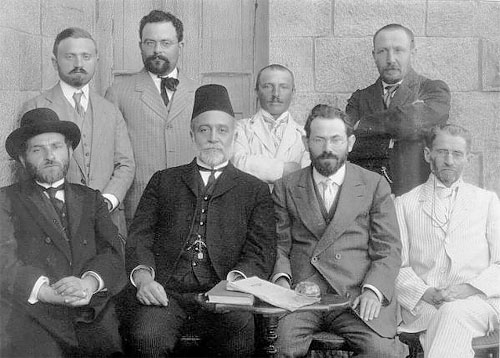
The first Hebrew Language Committee. Seated (right): Eliezer Ben-Yehuda, Yosef Klausner, David Yellin, Eliezer Meir Lipschitz; standing (right): Chaim Aryeh Zuta, Kadish Yehuda Silman, Abraham Zvi Idelsohn, Avraham Yaakov Barur.
From the moment he settled in Jerusalem, Ben-Yehuda worked tirelessly to renew Hebrew. Conditions were extremely difficult, and they only worsened. As a start, he decided to set a personal example and spoke only Hebrew at home.
This insistence on Hebrew at home became a catalyst for coining new words. Words such as “doll,” “ice cream,” “bicycle” and many others were invented to enrich the developing language for the sake of his young son. Ben-Yehuda’s dedication inspired other families to speak Hebrew as well, including the family of Yehuda Gur (later author of Gur’s Dictionary). According to stories, Ben-Yehuda’s wife even baked a cake for the tenth family that adopted Hebrew speech.
For a short period he taught at the “Torah and Craft” school of the Alliance Israélite Universelle in Jerusalem. One of the programs he strongly promoted was “Hebrew in Hebrew,” originally developed by Yitzhak Epstein. The method emphasized natural acquisition of language, multisensory learning, connection to the student’s interests, and the integration of songs and games. The method was adopted in several first-aliyah settlements and became a national educational tool.
Ben-Yehuda continued searching for new avenues to infuse Hebrew into daily life. He founded the newspaper HaTzvi to demonstrate how Hebrew could function as a modern language. The paper targeted young readers and required continual invention of new vocabulary and grammar. Eventually, HaTzvi lost popularity and was replaced by HaPo’el HaTzair, the voice of the second aliyah.
Alongside this, Ben-Yehuda founded associations to promote Hebrew. In 1882 he established the “Revival of Israel” group to encourage Hebrew speech, and in 1889 the “Clear Language Society,” which focused on teaching Hebrew and publishing instructional books. From this activity emerged the “Hebrew Language Committee.” Although it dissolved within a year, it formed the foundation of today’s Academy of the Hebrew Language.
After the committee’s dissolution, Ben-Yehuda focused on his life’s great project: the Ben-Yehuda Dictionary, an enormous historical dictionary containing many of his linguistic innovations. He completed only five volumes in his lifetime. The dictionary was finished fifty years later in 1959 by Naftali Herz Tur-Sinai, expanding it into sixteen volumes, each entry illustrated with extensive citations from classical Hebrew sources.
Among the many words he coined were “sidewalk,” “brush,” “train,” and “ice cream,” as well as numerous proposals that did not survive. For example: “avchametz” (oxygen), “bedura” (tomato), “madlek” (match), and “shach-rachok” (telephone).
In 1882, Ben-Yehuda’s son Itamar Ben-Avi was born (the name meaning “Ben-Yehuda, father of Itamar”). His original name was Ben-Zion Ben-Yehuda. Known as “the first Hebrew child,” he was the first child in modern times whose mother tongue was Hebrew. Like his father, he went on to become a journalist and Zionist activist, playing a major role in the development of Hebrew journalism. Among the words he coined were: independence, disappointment, automobile, wireless, newsletter, politician, clinic, armored, deck, umbrella and more.
At the end of 1922, after dedicating nearly his entire life to Hebrew, Ben-Yehuda died of tuberculosis. His personal archive, including documents, photographs and certificates, is preserved at the Central Zionist Archives in Jerusalem. Streets, schools and even the moshava “Even-Yehuda” are named after him. The poem accompanying this article was written by Yaron London and composed by Matti Caspi.
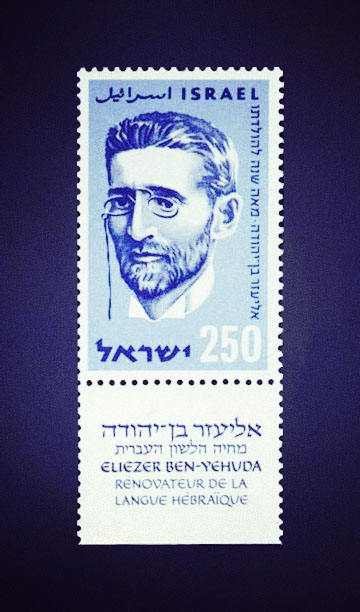
In 1957 a commemorative stamp featuring his portrait was issued, designed by Zvi Narkiss. In 2007, UNESCO recognized the 150th anniversary of his birth, declaring him an honoree. In 2012 his birthday was designated as Hebrew Language Day, and a year later Google released a special Google Doodle in his honor.
Above all, Ben-Yehuda is remembered as the man who revived the Hebrew language. His greatest impact was symbolic and ideological. He pushed tirelessly for Hebrew renewal, wrote and published in Hebrew, coined new words, edited newspapers and dictionaries, fought opponents, and served as a model of linguistic dedication. What began in the early Zionist settlements became, by the time of Israel’s founding, the daily spoken language of the Jewish community and the language of education. Today it is the official language of the State of Israel.